I’m down at Victor Harbor tonight packing my camera gear and loading 5×4 sheet film for my forthcoming trip to Tasmania. Half of the time on the island has been structured around photography in Queenstown.
fence
We went for an evening walk along the beach and amongst the houses set back from the beach. The sun was shining but the southerly wind was cold. It was jumpers and jeans –it was such a contrast to the warmth of Adelaide. I shivered, thinking how cold the south west part of Tasmania is going to be.
Now and again on the poodlewalks I take photos of the neighbourhood architecture in an exploratory sort of way. Some of the architectural forms in the built environment is visually interesting–both the heritage buildings and the postmodern ones. Modernism is exhausted.
However, I haven’t really gone that step further and started taken architectural photos with a view camera, even though I’ve uncovered some possibilities.
SAMFS Adelaide fire station
I have intended to do so–its the traditional way is it not?—but I haven’t explored the different perspectives in architectural photography, or rather the different ways of photographing architecture.
There are not that many retail shops in the urban neighbourhood in which our town house is located. It is part of the south-western corner of Adelaide’s CBD. It was mostly light industrial plus working class housing area in the 20th century. In the 21st century it is undergoing regional regeneration as residents, lawyers and small business move in.
The most fascinating part of this regeneration are the international students and the emergence of educational and other supoorting services (food, hairdressers, supermarkets, fashion etc) in and around the Central Market precinct.
white belt
This has bought some energy and life to Adelaide’s deadened CBD —-this precinct is now overflowing with people going about their everyday lives; relaxing in the coffeeshops and restaurants; and just hanging about enjoying themselves.
We were down at Victor Harbor over the weekend and so the poodlewalks were along, and around, the coastline. This is the image that I wanted to take with the 5×7 Cambo view camera, but the weather was against me. There were strong winds blowing from the south west across the top of the cliffs and this made it impossible for me to use a view camera.
coastline, looking to The Bluff
So I had to give it up even though I’d finally found the location I was looking for. I have been exploring this coastline for several years, as it is our backyard so to speak. I now find I’m reworking it with a digital camera looking for a photographic image.
Yesterday we started to explore the west parklands in which the West Terrace Cemetery is situated. The part of the parklands that is next to West Terrace itself consists of soccer fields. Further west, adjacent to the northern side of the cemetery and running down to the railway line is a cultivated wilderness area with a wetlands known as Wirranendi Park.
Wirranendi is from the Kaurna aboriginal language and it means to become transformed into a green-forested area. The park is cultivated in the sense that it is being replanted with natives, and is a site for public sculptures that are far more intriguing than any art in public places in the CBD.
Adelaide, whose self-image is that it is an arts and festival city, has had an ironic shortage of contemporary public art, and what it does have is banal-eg., the brass pigs in Rundle Mall. Adelaide needs to reinvent itself.
Lie of the Land
The work above is a public space installation titled “Lie of the Land”, located in the Adelaide parklands on the “Western Gateway” to Adelaide City and was created by Victorian-based artists Aleks Danko and Jude Walton. The work consists of 25 stone domes stretched along either side of Sir Donald Bradman Drive east of the Hilton bridge. Each dome is made from local bluestone using the dry-walling technique.
“Lie of the Land”, with its closed forms and no opening, refers back to the way the early settlers sheltered in dome shaped structures they had copied from the Aborigines. The beehive shaped shelters were built by the early European settlers (immigrants) and that they used traditional aboriginal materials to construct them.
I had intended to take my cameras on a heritage walk at the old Torrens Island Quarantine Station at the mouth of Adelaide’s Port River, this afternoon, but the city was gridlocked due the Clipsal 500 car race. It took me ages to get out of the CBD and by then it was too late to make the run down to the Port before 6pm.
So the poodles and I went to the West Adelaide Cemetery instead, and I picked up my photography from where I had left off in the early summer:
West Terrace Cemetery
We forgot about clock time during our wanderings and I didn’t realize that all the gates had been closed. We were locked in and the old hole in the fence that we’d often used had been repaired. We were locked in, so we had to search for a place in the fence for the poodles to scramble under the wire fence and for me to climb over it.
I was out at dawn this morning lugging the Cambo 5×7 monorail, Linhof tripod and computer bag of double dark slides down to Kings Beach to have the camera set up before the early morning sunlight became too intense.
There was just enough cloud cover to keep the sun covered long enough to give me the extra time that I needed to set the camera up:
5x7 Cambo
I had around a 20 minute time frame in which to work to take the photos before the early morning light became too bright.
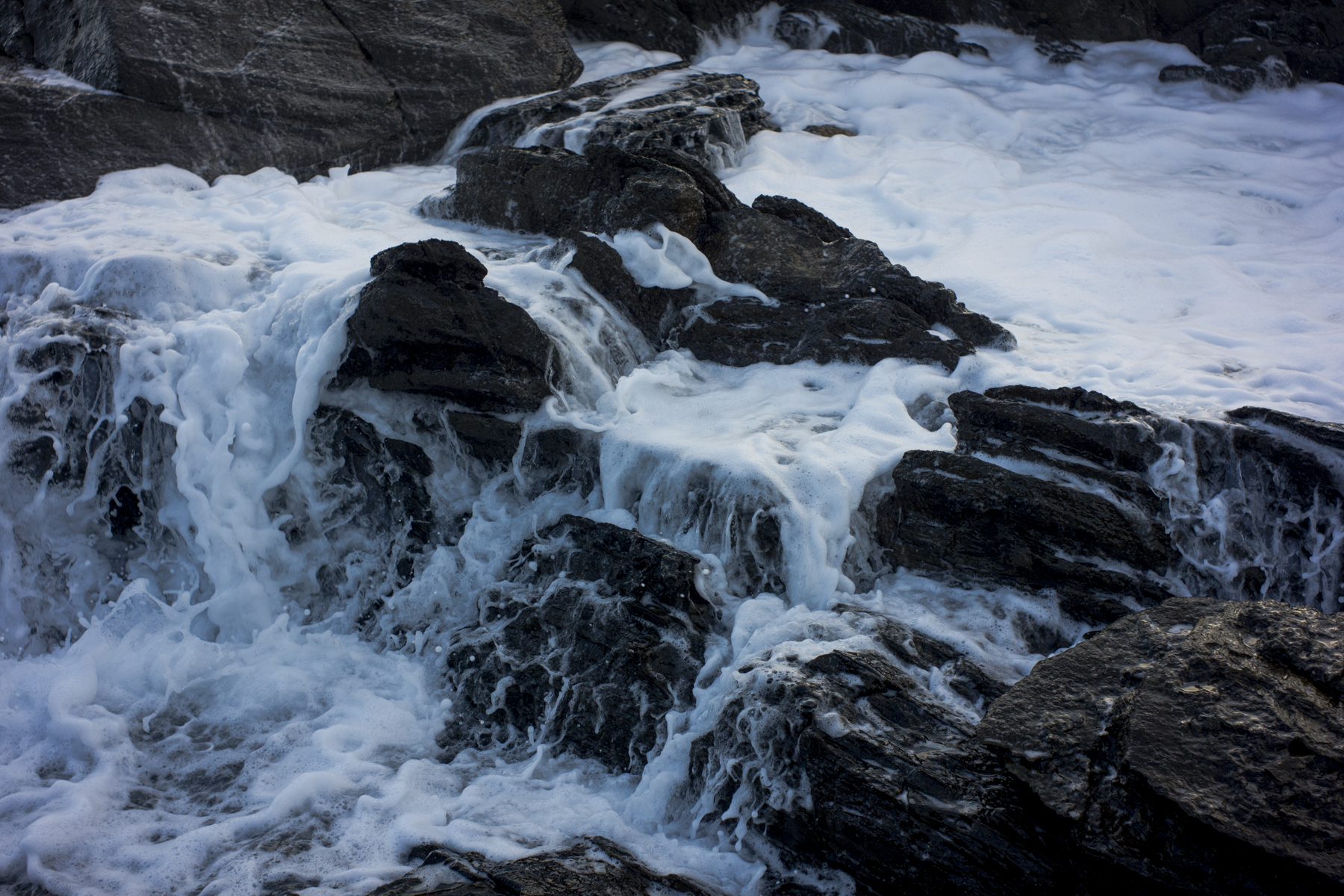
Dusk on Saturday was the ideal time to take photos with the 5×7 Cambo monorail of the coastline of the southern Fleurieu Peninsula. It was very still, very warm, and there were amazing colours. It was magic time. For some reason I was exploring the rocks around Kings Beach with the poodles with my point and shoot Sony. I returned home around 7pm–just when I should have been using the large format camera.
The weather on the southern Fleurieu Peninsula changed the next morning:–the strong south westerly winds made impossible to photograph along the coast with a large format camera.
rocks, Kings Beach
As I mentioned in my earlier post on Kangaroo Island my shift back to large format was a result of the poor quality of the pictures I achieved with digital on the Kaangaroo Island shoot.
Over the next couple of years I shot only in raw, shifted to Apple computers, acquired Lightroom, started using medium format cameras more extensively–I bought a Rolleiflex 6006 system. I then picked up my old large format cameras rather than spend $15,000 to $30,000 on a medium format digital camera.
We are at Victor Harbor for the long weekend along with heaps of other people who are having fun. It is definitely early autumn on the Fleurieu Peninsula, for though the days are hot, the early morning air is crisp and the nights are cool.
I have been going through my digital archive, looking at the pictures that were initially taken with the digital point and shoot around 2007 on a trip we did to Kangaroo Island in autumn 2007:
dead tree
I’ve never really looked at the pictures closely. They had the date digitally stamped all over them and they were not shot as jpeg’s and not in raw. I didn’t really know what I was doing then. A friend set the camera up for me–the menu looked looked far too complicated after a using a Lecia rangefinder — and I could not understand the ‘how to’ booklet. Everything on the camera was set on automatic.
One of the more noticeable aspects of urban life in the inner city of Adelaide is the number people staggering around the streets after having too much to drink. I notice them more than usual because the poodles are very aware of them –the behaviour of drinks is unpredictable because they stagger.
drinkwalk
The drunks are often the homeless older men, aborigines who spend the day in the parklands, and young men staggering around the streets after boozing all night in the nightclub strip. The latter are the most violent and are often aggressive. They are to be avoided because the poodles will attack them if they get too close.