
I made this picture whilst we were wandering our way to see the Jeffrey Smart exhibition at the Samstag Gallery. We were to meet up with Suzanne and then look over the exhibition.
It took Ari and myself a couple of hours to get there, as we more or less strolled up and down all the little streets and alleyways between Sturt St and the gallery on North Terrace. There was so much to check out.
Franklin St. Adelaide
I was trying to think through a different approach to photographing the city to the bird’s eye view from the top floor of carparks. I was experimenting as we slowly weaved our way in and out of this part of the city, but I didn’t come up with much.
I’ve finally recovered enough from an illness to start walking the streets around Adelaide with Ari with a camera. It was a short stint around my urban neighbourhood in the late afternoon on the long weekend.My eye was seduced by the windows of an empty shop in Gilles Street. It looked surreal:
shop windows, Gilles St, Adelaide
The empty shops in the CBD are increasing. People just aren’t spending. Some–eg., restaurants–cannot hang on until the postponed mining starts. So they go bust. Just after making the picture I was hassled by an aggressive paranoid schizophrenic who took great exception to me with a standard poodle walking the streets.
Last week, on one of our back country road walks looking for possible pictures for the conceptual photography book on pink gums and Xanthorrthoea, Ari and I stumbled across this scene:
roadside vege, Mt Hill Rd, Victor Harbor
It looked good on the computer screen–a candidate for the book— and so we went back on the following afternoon to reshoot it with a film camera. But I couldn’t find it, even though I searched everywhere. As I’d deleted most of the pictures on the SONY NEX-7 I couldn’t retrace my steps from the sequence of pictures. I returned the following morning and started from the other direction of the walk to no avail.
Southerly storms have been hitting the southern coast of the Fleurieu Peninsula since Thursday night. The south westerly winds have been very strong whilst the showers of the last day have been frequent and intense. So it is a matter of trying to walk between the showers and staying away from the cliff tops.
We had one such moment yesterday on the late afternoon walk:
grasses, Victor Harbor
We strolled around the Victor Harbor rubbish dump trying to avoid all the mud, and keeping an a eye on the clouds rolling in. We only had 20 minutes or so between the showers. So there wasn’t much chance to experiment with a digital camera.
Ari and I went walking along a back country road west of Victor Harbor yesterday afternoon looking for more material for the conceptual photography book I didn’t find much in the way of the pink gum and Xanthorrhoea combination, but it was an enjoyable walk along Wilson Hill Rd. I found myself wondering how difficult it would be like to take pictures with a digital field view camera. Would it need to be tethered to a computer?
on Wilson Hill Rd, Victor Harbor
This part of the Fleurieu Peninsula region is dairy country and there is very little native bush left. This region been extensively cleared.
Thinking in terms of regionalism—the expression of a type of local identity—recalls the divisions between figuration versus non-figuration, and regionalism versus internationalism in the early 1970s where there was an identification of foreignness with non-figuration that was set against an emerging post-colonial regional cultural identity (Antipodeanism) that did not seek to create a national style.
Ari and I wandered around Bowden late this afternoon.
I’d gone there to check out Fontanelle, as I understood that there was a darkroom there and workshops on alternative technologies, processing and printing called The Analogue Lab. I was looking for a darkroom in Adelaide to develop my 8×10 black and white sheet film. I presumed that this photographic facility is run in association with the Fontanelle Gallery and Studio in Bowden. Everything was closed.
So Ari and I went walking around the streets. I took a few snaps. This picture of industrial forms (Conroys Smallgoods) was in Sixth Street, just down the road from Fontanelle before the Drayton Street corner. I used to work at Conroys when studying at Flinders University and the money I earned there enabled me to set myself up with different types of large format cameras.
Conroys, Bowden, Adelaide
Bowden was located close to the city, park lands and the train line and it is where I used to live and work in the 1980s. I had a photographic studio and darkroom in Gibson St near Seventh St, and I used to walk around the area and photograph it with medium and large format cameras. I also spent a lot of time walking in the western parklands with Fichte, my standard poodle.
Though I’d develop the film myself, I was never much good at printing (ie., producing a fine print), so I never exhibited the work about Bowden as a place. I just built up an archive of negatives in a filing cabinet. I’ve started to revisit and to digitalize.
It has been a while since I’ve wandered the streets of Adelaide on a daily walk with Ari and a digital camera. Today was the first day that I returned to walking the streets taking photos:
Ari, Adelaide
I was wanting to take more street level photography for the Adelaide book. The draft is top heavy with ‘birds-eye’ views of the city. I wondered if the digital camera become a tool of the flâneur who walks the city in order to experience the present conditions of daily urban life. This urbanscape in which we live which is often ignored or taken for granted.
The idea of the flâneur returns us to the Situationists concept of psychogeography, which is the practice of exploring places in unpredictable ways within the society of the spectacle. This is connected to a favorite practice of the dadaists, who organized a variety of expeditions, and the surrealists, for whom the geographical form of automatism was an instructive pleasure.
I’ve been glancing through Anne Marsh’s recent book Look: Contemporary Australian Photography since 1980 (2010) looking at what kind of photography of Australian cities has been done. This work is in the Space section of the text, which also includes suburbs, inhabitants (people in urban settings) and rooms as well as cities.
There is much more photography on suburbs than cities. Surprisingly the photographic representations of cities in the Marsh text is very thin. Disturbingly thin. Australian photographers, apparently, live in the suburbs not the inner city. When they turn to the urban their focus is on people, where they work in the humanist street photography tradition.
There is no text from Marsh on this mish mash of work by Daniel Crooks, Sandy Edwards, Rozalind Drummond, Robyn Stacey, Les Walking, Ian De Cruchy, Simon Cuthbert, Carl Warner and Kit Wise. There is more interesting work on Flickr.
Leigh St, Adelaide
Leigh St in Adelaide has been selected to become the Adelaide equivalent of a Melbourne laneway. It will be closed off to traffic with the hope that it becomes a vibrant space full of people eating, drinking and conversing with friends. The programme to make Adelaide a vibrant and lively place is called Splash.
Suzanne, Ari and I spent the day in the McLaren Vale wine region taking in the various exhibitions in The Shimmer 2012 Photography Festival. It was organized around a birthday lunch for Suzanne at Penny’s Hill.
Primo Estate, McLaren Vale
I was really fascinated by Alice Blanch’s Box Brownie black and white landscapes where she is using the technology of another era with all its shortcomings as the basis for a new view of old subject matter.
Ari and I cruised the beach at Encounter Bay this morning at sunrise. It was a warm spring morning. The tide was low, the sun light was soft because of the cloud cover, and there was no wind. There was no one around and we had the beach to ourselves. The clouds disappeared and the wind came up after we’d finished our walk.
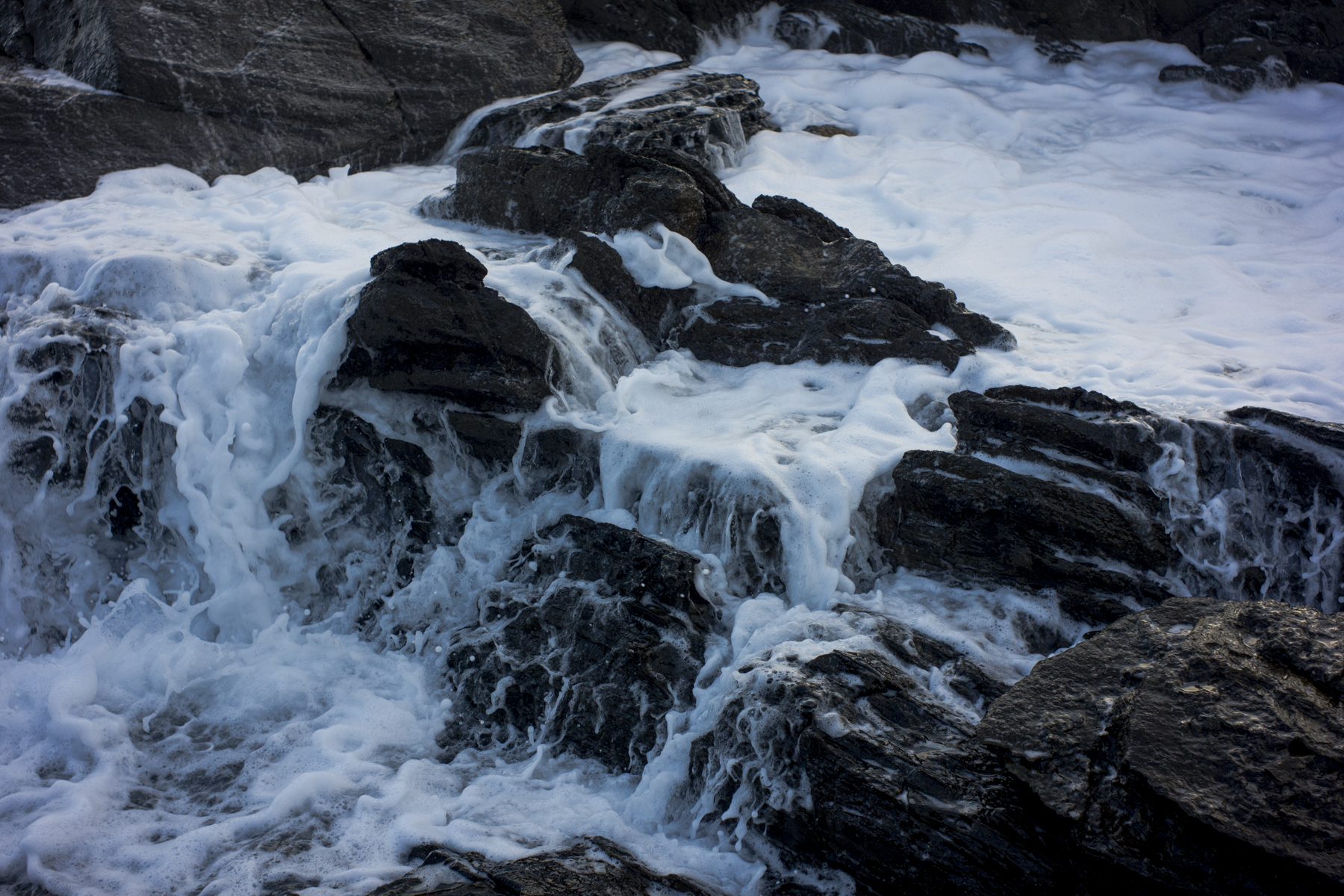
These rocks are along the foreshore. They are part of a large mass of rocks that had been put there by the council long ago to protect the footpath along Franklin Parade from the sea. They gleamed in the early morning light. I couldn’t resist taking a snap.
7am Encounter Bay, Victor Harbor
I’ve come down to Victor Harbor after hanging some pictures of the Fleuriu Peninsula in the Tin Shed Cafe in McLaren Vale as part of the Shimmer Photography Festival. It’s very low fi because I cannot afford to have a large exhibition with a substantial body of work. I have to work towards it.